2021
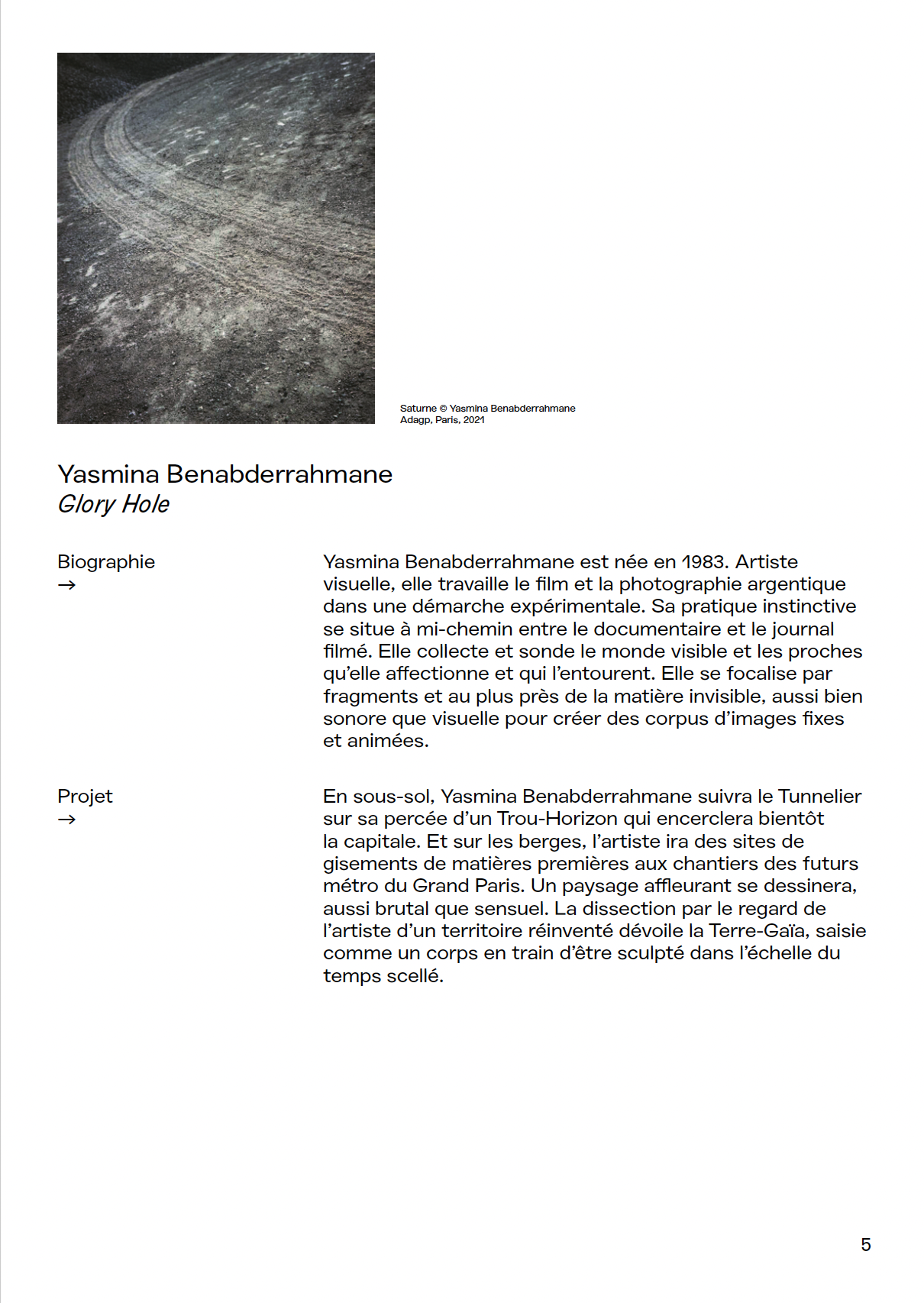
Yasmina Benabderrahmane - 'Glory Hole'
Text by Marta Jecu
Pour le philosophe Dylan Trigg, « être-dans-le-monde » signifie d’abord être inscrit dans un lieu, un lieu émergeant de l'expérience propre au sujet. « Nous sommes toujours d’un ici, et c'est à partir de cet ici que se décident nos expériences » L'œuvre de Yasmina Benabderrahmane me semble appartenir à cette même recherche de se situer – à la fois d’un point de vue géologique et spirituel. Le rapprochement intime avec la terre, le sol, et, dans un sens plus large, avec le paysage tout entier est une quête de nos racines, d’une image disparate et fragmentée de notre propre identité. Dans le travail de Yasmina Benabderrahmane, le territoire est observé et profondément disséqué. Au point de dévoiler progressivement le paysage comme relevant de l’intime, d’une appartenance à un lieu. Dans sa démarche, le préalable de l'observation est abyssal. Il plonge dans la mémoire de paysages ancestraux et collectifs, tout autant prétexte à exploration que mise en scène de l’intime de l'artiste.
Le débat est ancien pour savoir si le paysage est quelque chose en soi ou se constitue dans le regard que nous portons sur lui. La géographe Gillian Rose estime que le paysage est « une manière de voir ». Mais Tim Ingold a été l'un des premiers anthropologues à contester le fait que le paysage ne soit qu’une construction culturelle ou symbolique. Selon lui, le paysage cesse d'être le cadre des activités sociales et culturelles pour devenir l’archive des générations passées qui l'ont habité « et qui, ce faisant, y ont laissé quelque chose d'elles-mêmes ». « Là où la terre est quantitative et homogène, le paysage est qualitatif et hétérogène (...). Le paysage est un plénum ».
Cette perspective holistique du paysage est caractéristique du travail de Yasmina Benabderrahmane, notamment avec "Glory Hole" qui documente, par un film en super 8 / 16 mm, l’aménagement des métros en cours de la Société du Grand Paris . La cartographie urbaine des déplacements, mais aussi celle des industries et des déserts urbains que génère le projet du Grand Paris relève d’une anamnèse. Documenter ainsi l'incursion de lourdes machines de chantier dans les couches profondes, viscérales, d'un territoire anthropomorphisé évoque le phénomène de régression qui, en psychanalyse, actualise, situe et permet de se réapproprier ce dont nous sommes faits – une appartenance sédimentée à un lieu ancestral, un traumatisme collectif, une histoire obsédante. Une once d’érotisme et sensualité traverse aussi ces associations, dans lesquelles la surface de la pellicule, la sensualité charnelle de la peau de la terre et le regard lui-même fusionnent, révélant le paysage comme une forme de désir visuel.
*Marta Jecu
*Marta Jecu
-
For Dylan Trigg, being-in-the-world means being placed and place is emerging from the experience of a subject. 'We are forever in the here, and it is from that here that our experiences take place' (Trigg 2013:4).
The work of Yasmina Benabderrahmane is for me essentially a search of being situated – geologically and spiritually. The intimate approximation to land, earth, stone and in a broader sense landscape, is the search for heritage, in its disparate, fragmented image of identity.
In her work territory is both observed and dissected in profundity, while progressively revealing landscape as being interior, connected to the self and to belonging. Observation is in her work abyssal. It goes back to ancestral and collective landscape-memories, which at the same time become explorations of the artists' own complex enactments of the self.
There is a long discussion if landscape it something in itself or if landscape is within the gaze. Gillian Rose (1993) famously said that landscape is 'a way to see'. But Tim Ingold was one of the first anthropologists to contest that landscape is a cultural or symbolic construction (Ingold 1993: 154). With him, landscape stopped being a scenography for social and cultural actions, but became an archive of past generations which lived in it ‘and in doing so have left there something of themselves’. (Ingold 1993: 153). 'Where land is quantitative and homogenous, the landscape is qualitative and heterogenous (…). the landscape is a plenum'. (Ingold 1993: 171)
This holistic perspective on landscape is characteristic of the work of Yasmina Benabderrahmane, and especially in 'Glory Hole' which follows in super 8 / 16 mm film, the development in progress of the metros of the Société du Grand Paris
The mapping of the urbanistic displacements of neighbourhoods and industries and the urban deserts that the project 'Grand Paris' generates, recalls an anamnese. Documenting the heavy machines' foray within the visceral layers of an anthropomorphised and appropriated territory, recalls psychoanalytical regression that actualizes, situates and re-appropriates what we are made of - the sedimented belonging to an ancestral place, collective trauma, the haunting history. An erotic, sensual note traverses these associations, in which the film surface, the carnal sensuality of earth's skin and the gaze itself fuse, revealing landscape as a form of visual desire.
*Marta Jecu
CITED REFERENCES:
Trigg, Dylan, The Memory of Place: A Phenomenology of the Uncanny (Volume 41) (Series In Continental Thought) Paperback – Illustrated, March 15, 2013
Ingold, Tim. 1993, The Temporality of the Landscape, World Archaeology. Conceptions of Time and Ancient Society.
Rose, Gillian. 1993, Feminism and Geography, Polity Press, Cambridge, UK